Suguru Geto in Jujutsu Kaisen: The Worst Curse User Explained
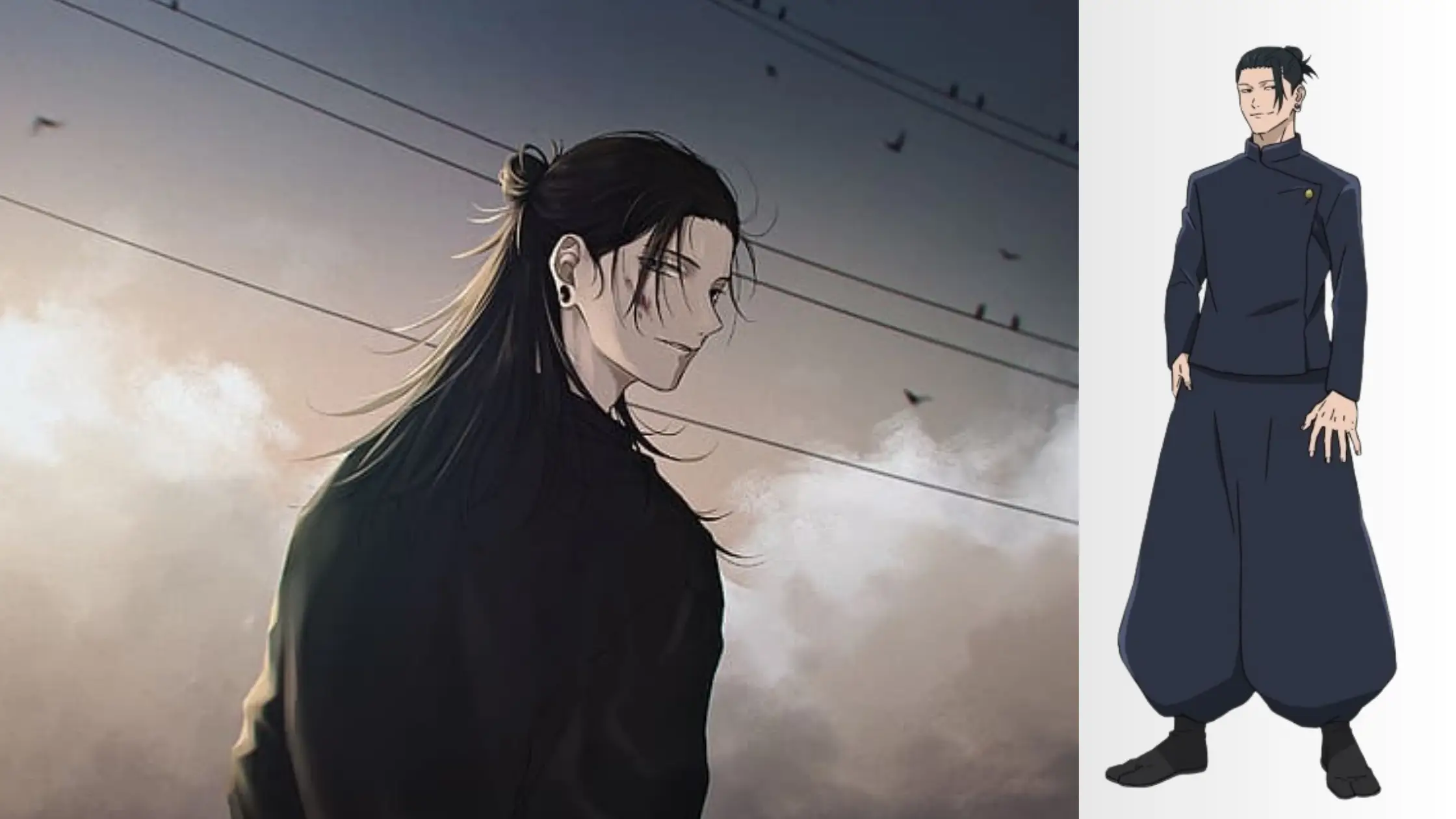
Suguru Geto (夏油傑) is a Special Grade jujutsu sorcerer, the former best friend of Satoru Gojo, and the main antagonist of Jujutsu Kaisen 0. He is the person Gojo considered his equal during their time as students, the person whose fall from grace is the series’ foundational tragedy, and the person whose corpse Kenjaku inhabits for most of the main series.
He was not always the worst curse user. He was once the kind of person who argued that sorcerers had a duty to protect people. The distance between those two versions of himself is what Jujutsu Kaisen is partly about.
Character Profile
| Detail | Information |
|---|---|
| Full Name | Suguru Geto (夏油傑) |
| Grade | Special Grade Jujutsu Sorcerer |
| Affiliation | Tokyo Jujutsu High (former) — independent curse user |
| Cursed Technique | Cursed Spirit Manipulation |
| Signature Move | Maximum: Uzumaki |
| Adopted Daughters | Mimiko Hasaba, Nanako Hasaba |
| Status | Deceased — killed by Gojo on December 24 |
| Birthday | February 3 |
| Age at Death | 27 |
| Favourite Food | Zaru soba |
| Voice Actor (JP) | Takahiro Sakurai |
| Voice Actor (EN) | Lex Lang |
Who Is Suguru Geto?
Suguru Geto is a Special Grade sorcerer who began as Gojo’s most important friend and equal, spent years absorbing cursed spirits and watching non-sorcerers generate more of them through their negative emotions, broke after a specific injustice in a village, and became the most dangerous curse user of his era.
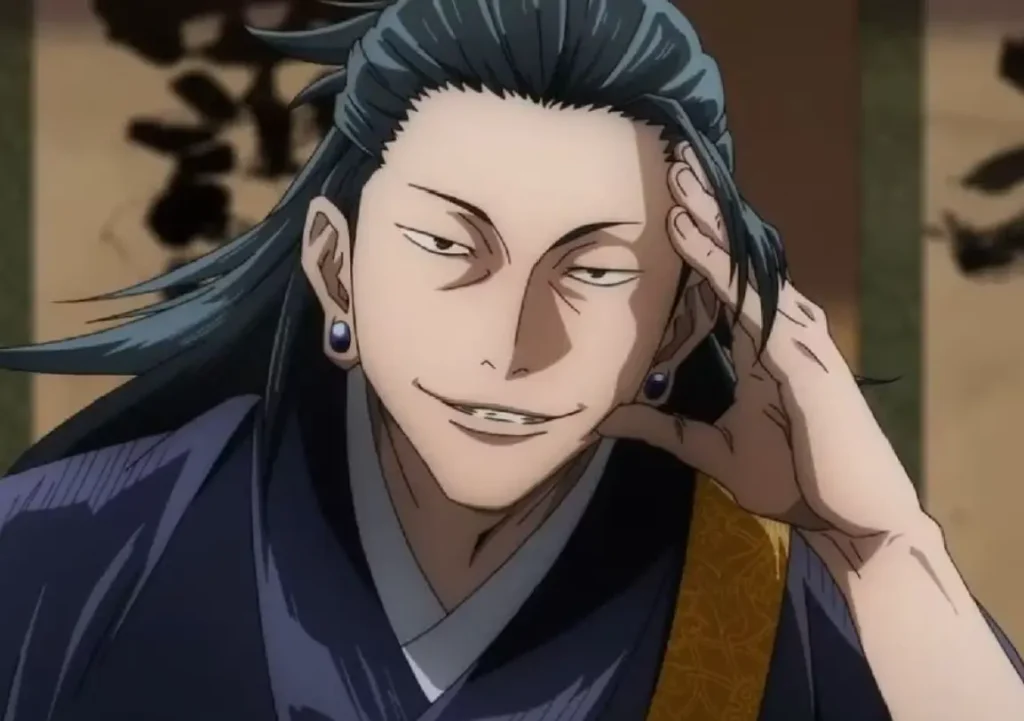
He is tall and lean with long black hair partially tied into a bun, thin black eyes, and distinctive front bangs that multiple characters comment on. Riko Amanai called them weird when she first met him. Gojo noted them too. He carries himself with the same easy confidence as Gojo but expresses it differently — where Gojo is loud, Geto is smooth and well-spoken, occasionally slipping into condescending mockery so politely delivered it takes a moment to register.
His name was inspired by the Geto Kogen ski resort in Japan. Akutami liked the sound of it. The name’s kanji means “outstanding” — fitting for a person who reached the highest tier of sorcery through effort rather than innate gift. Gojo’s name means enlightenment and he was born with it. Geto’s name means outstanding and he earned it. That distinction is embedded in how Akutami wrote both characters.
Akutami created Geto specifically to explore a character with a heavily skewed ideology after being inspired by Shinobu Sensui from YuYu Hakusho — a villain with a similar ideological collapse. Akutami was disappointed with Sensui as a result and felt he could write the concept more successfully. Geto is the attempt to do it better.
What Is Cursed Spirit Manipulation?
Cursed Spirit Manipulation allows Geto to capture any natural cursed spirit he defeats, absorb it into a small black orb, store it indefinitely, and deploy it as a weapon on command — turning every mission into an opportunity to expand his arsenal.
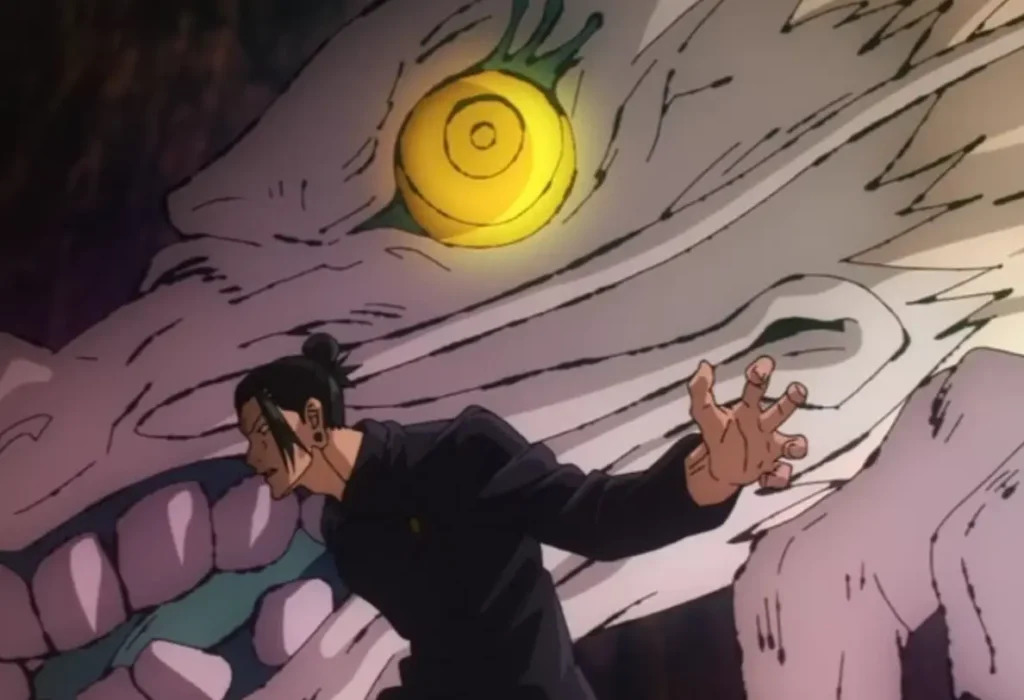
The technique works by converting defeated curses into black spheres that Geto physically consumes and stores inside himself. He can only absorb curses whose masters he has already defeated. Attempting to absorb a curse belonging to a living master physically repels the attempt. Once absorbed, curses can be summoned and commanded like shikigami — but with far more variety and power than any single shikigami technique could provide.
The technique’s ceiling scales with Geto’s collection. By the time of JJK 0 he has accumulated 6,462 cursed spirits over a decade of deliberate collection, operating a fake Buddhist temple that attracted cursed humans seeking relief from their ailments. He deployed 2,000 of those curses simultaneously across Kyoto and Shinjuku during the Night Parade of a Hundred Demons.
The technique has one catastrophic psychological cost: Geto describes absorbing cursed spirits as eating a rag used to clean vomit — a sensation nobody else in the world can understand. Years of this endlessly repeated cycle, exorcise a curse, consume it, exorcise another, consume another, with no end in sight, gradually distorted his sense of what he was doing and why.
Maximum: Uzumaki
Uzumaki is Geto’s most powerful technique. It releases all stored cursed spirits simultaneously as a concentrated single blast that extracts their techniques and merges them into one overwhelming attack. It is the technique he uses against Yuta Okkotsu during JJK 0 and the same technique Kenjaku uses to absorb Mahito after Shibuya.
What Is Geto’s Ideology and Where Did It Come From?
Geto’s ideology — eliminate all non-sorcerers to create a world where only sorcerers exist and curses cannot form — is not the starting point of his character. It is the endpoint of a slow collapse that begins with genuine compassion and ends with a specific moment of injustice he cannot move past.
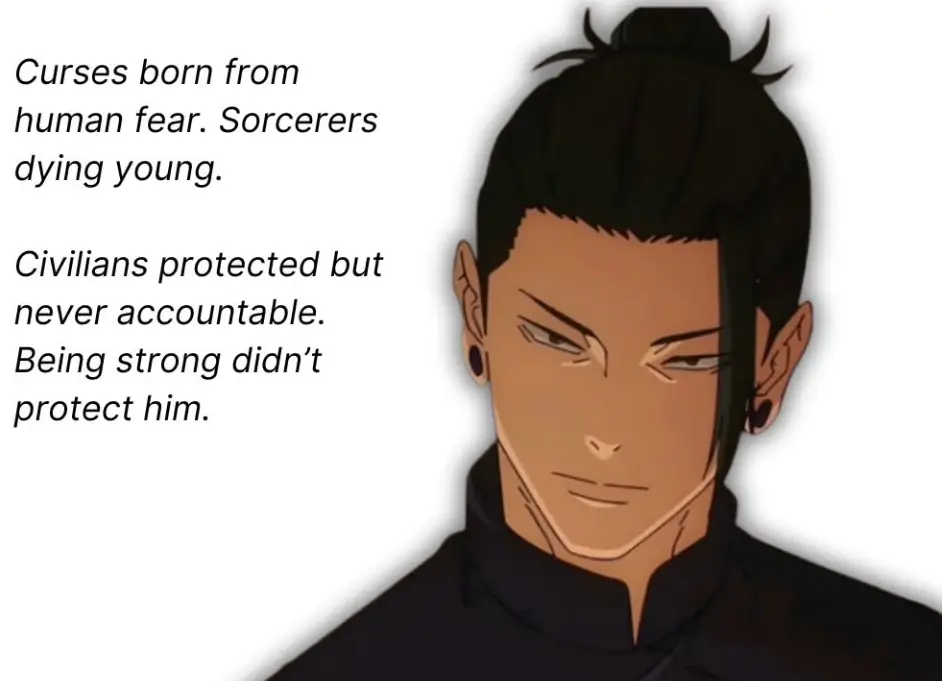
As a student, Geto believed sorcerers existed to protect people. He and Gojo argued about this constantly. Gojo thought applying moral reasoning to jujutsu was pointless. Geto thought it was essential. He was the more traditionally ethical of the two.
Yuki Tsukumo visits Geto after the Riko Amanai mission and articulates something he had been circling around: non-sorcerers are the primary reason cursed spirits exist. Their uncontrolled negative emotions generate far more cursed energy than sorcerers produce. Yuki presents two theoretical solutions — eliminate non-sorcerers entirely, or teach everyone to control their cursed energy. She does not advocate for either. She is presenting the problem clearly. Geto hears the first option and cannot stop thinking about it.
The breaking point comes during a village mission. Geto exorcises the curse attacking the village. The villagers then ask him to also kill two young girls — Mimiko and Nanako Hasaba — who have sorcerer ability and are therefore considered dangerous and unwanted. Geto has just protected these people. They are asking him to execute children as payment. He kills the villagers instead. He takes the girls. He kills his own parents. He contacts Gojo in Shinjuku and explains what he is going to do and why.
The logic is brutal and internally consistent: non-sorcerers cannot control the negative emotions that generate curses. They cause the suffering that sorcerers spend their lives cleaning up. They cannot see what they are doing and cannot be made to stop. The only solution Geto can arrive at is removing them from the equation entirely.
The manga does not present this as correct. It presents it as the conclusion a person in genuine anguish reaches when the institution they serve fails them repeatedly and the people they protect respond to their service with requests to murder children.
What Happens to Geto in the Story?
Geto is Gojo’s best friend as a student, breaks during the Gojo’s Past Arc, spends a decade building a cursed spirit army, executes the Night Parade of a Hundred Demons in JJK 0, is defeated by Yuta, and is killed by Gojo on December 24.
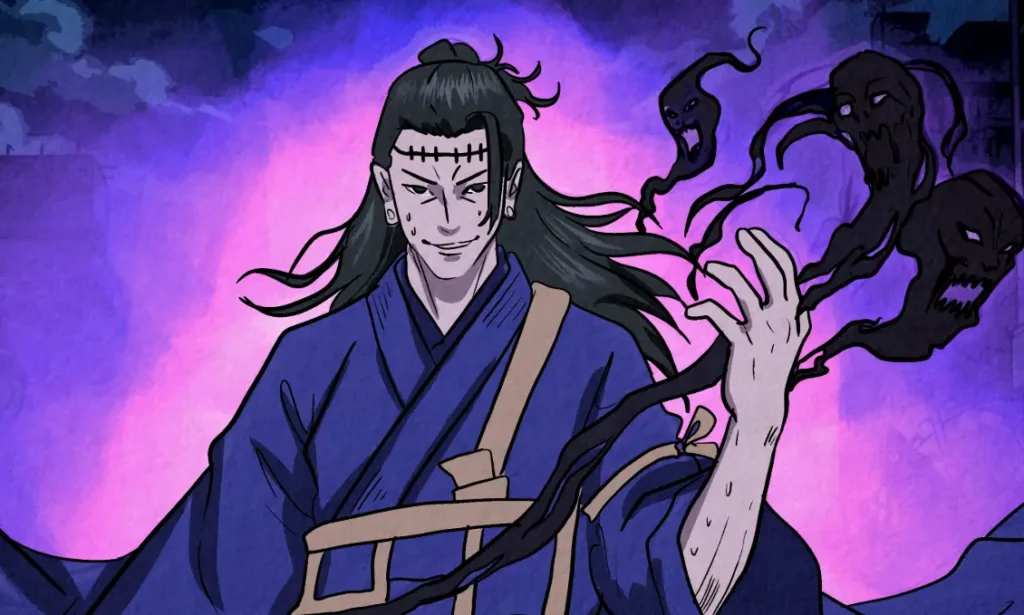
Gojo’s Past Arc
Geto and Gojo escort Riko Amanai as students. Toji Fushiguro kills Riko before the merger can happen. The Time Vessel Association publicly celebrates her death. Geto watches people applaud the murder of a teenage girl he was assigned to protect and asks Gojo the question that defines everything afterward: what is the most humane way to exterminate non-sorcerers? Gojo deflects. They part ways differently than they came.
Read from Chapter 65 through Chapter 79.
Jujutsu Kaisen 0
Geto executes the Night Parade of a Hundred Demons — deploying 2,000 curses across Kyoto and Shinjuku simultaneously. The real goal is not the destruction but to isolate Jujutsu High and steal Rika Orimoto from Yuta. He fights Yuta directly when the plan reaches its conclusion. Yuta, with Rika fully manifested, defeats him. Gojo finds him afterward and kills him — not in anger, but as the only act of care he has left to offer. Geto tells Gojo he could not be happy in this world no matter what. He says Gojo should have cursed him. Gojo does not.
Gojo kills him on December 24. He does not have Geto’s body taken by Jujutsu High. That decision allows Kenjaku to take it.
After Death
Akutami compared Geto’s remaining consciousness under Kenjaku’s possession to a decapitated dragonfly — the body moves but the original mind is gone. However, when Kenjaku uses Geto’s arm to wave at Gojo during Shibuya, Gojo senses something deeply familiar in the movement. Akutami confirmed this hints that the real Geto is faintly still present, fighting against Kenjaku from within.
Geto appears in Gojo’s afterlife airport scene at the end of the manga, standing with Nanami, Haibara, and others who died. The real Geto — not Kenjaku — is there. He found peace somewhere outside the body that was taken from him.
What Does Geto Represent?
Geto is the manga’s most complete portrait of how a genuinely good person becomes a villain — not through sudden corruption but through accumulated grief, institutional failure, and a logical framework that arrives at a monstrous conclusion through comprehensible steps.
He and Gojo started in the same place. They had the same capability, the same training, the same understanding of the jujutsu world’s flaws. Gojo responded by becoming the strongest and working within the system on his own terms. Geto responded by building an alternative to the system entirely. Neither response is fully right or wrong. Both are consequences of the same broken institution.
His relationship with Gojo is the series’ most important — not because of their fights but because of what their friendship reveals about both of them. Gojo becomes the strongest. Geto becomes the worst curse user. The distance between those two outcomes, from the same starting point, is what the manga asks you to hold.
For more on the arc that defines him see Gojo’s Past Arc and why death is central to Jujutsu Kaisen.