Best Mangas for 13 Year Olds

Manga, the Japanese style of graphic storytelling, includes a wide range of genres that suit different age groups. Manga for young teenagers focuses on clear storytelling, positive character development, friendship themes, and adventurous plots that avoid graphic violence or mature themes. Publishers such as Shueisha, Kodansha, and Shogakukan classify many series under the shōnen category, which targets readers between 12 and 18 years old.
Parents and young readers searching for manga suitable for a 13-year-old reader require titles that balance entertainment, character growth, humor, and action while remaining appropriate for early teenage audiences. Several globally recognized manga series meet these criteria and maintain strong readership among middle school audiences.
The following sections identify manga titles that match this age group, explain their themes, and show how each story supports reading engagement and positive storytelling for young readers.
What are the best mangas for 13 year olds?
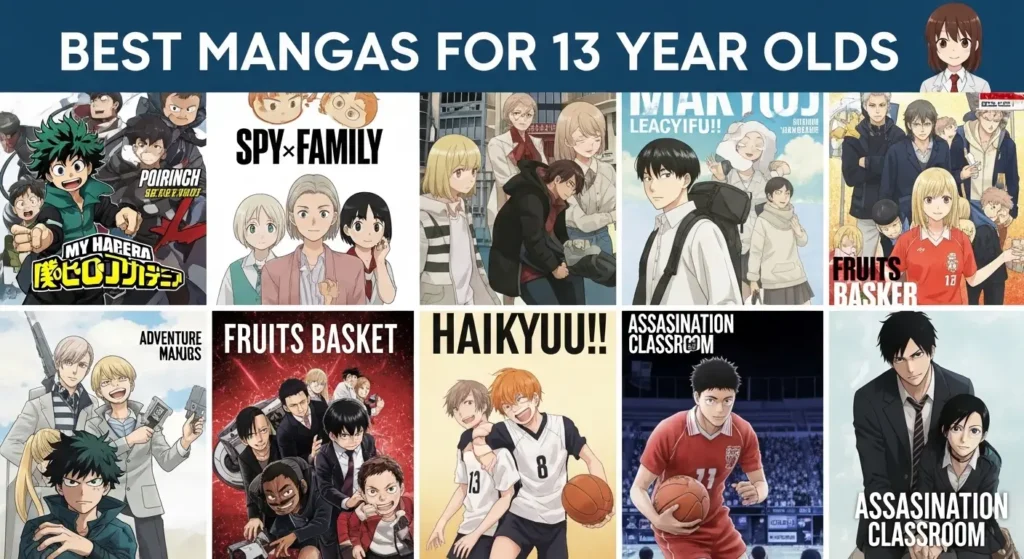
The best mangas for 13 year olds include My Hero Academia, One Piece, Naruto, Demon Slayer, Haikyuu, Spy x Family, Dr. Stone, and Pokémon Adventures because these series combine adventure, humor, friendship, and character growth while maintaining age-appropriate storytelling.
These manga series belong mainly to the shōnen manga category, a publishing demographic designed for teenage readers. Their narratives highlight teamwork, perseverance, and personal development. Publishers such as Shueisha’s Weekly Shōnen Jump and Kodansha’s Bessatsu Shōnen Magazine regularly publish these stories.
Young readers follow protagonists who develop abilities, form friendships, and solve challenges. Characters such as Izuku Midoriya, Monkey D. Luffy, Naruto Uzumaki, and Tanjiro Kamado represent determination, loyalty, and moral responsibility, which align with themes frequently present in youth literature.
How do popular manga series for teenagers compare?
The following table summarizes several manga series that suit 13-year-old readers. The comparison includes the author, publisher, main genre, and story focus.
| Manga Title | Author | Publisher | Genre | Main Themes |
| My Hero Academia | Kohei Horikoshi | Shueisha | Superhero, Action | Hero training, responsibility |
| One Piece | Eiichiro Oda | Shueisha | Adventure, Fantasy | Friendship, exploration |
| Naruto | Masashi Kishimoto | Shueisha | Ninja, Action | perseverance, teamwork |
| Demon Slayer | Koyoharu Gotouge | Shueisha | Adventure, Historical Fantasy | family, courage |
| Haikyuu!! | Haruichi Furudate | Shueisha | Sports | teamwork, discipline |
| Spy x Family | Tatsuya Endo | Shueisha | Comedy, Spy | family bonds, secrecy |
| Dr. Stone | Riichiro Inagaki & Boichi | Shueisha | Science Adventure | innovation, knowledge |
| Pokémon Adventures | Hidenori Kusaka | Shogakukan | Adventure | exploration, strategy |
This comparison shows that most age-appropriate manga combine action, humor, and learning elements while maintaining positive character development.
What is My Hero Academia and why is it suitable for young teens?
My Hero Academia is a superhero manga written by Kohei Horikoshi that follows a young student training to become a professional hero in a society where superpowers exist.
The story centers on Izuku Midoriya, a boy born without superpowers in a world where most people possess unique abilities known as Quirks. Midoriya receives a powerful ability from the legendary hero All Might and enrolls in U.A. High School, an academy that trains future heroes.
The narrative focuses on hero ethics, teamwork, and responsibility. Students learn how to use abilities to protect civilians. These themes align with positive character development and structured hero education.
What is One Piece and why do teenagers enjoy it?
One Piece is a long-running adventure manga created by Eiichiro Oda that follows pirate captain Monkey D. Luffy searching for the legendary treasure called the One Piece.
The story takes place across a vast ocean world divided into regions such as the Grand Line and the New World. Luffy gathers a crew called the Straw Hat Pirates, including characters such as Roronoa Zoro, Nami, and Sanji.
The narrative focuses on loyalty, courage, and exploration. Each arc introduces new islands, cultures, and challenges. The global success of One Piece made it one of the highest-selling manga series in history according to Oricon Manga Sales Reports.
What is Naruto and why is it widely recommended for 13 year olds?
Naruto is a ninja adventure manga written by Masashi Kishimoto that follows a young ninja striving to become the leader of his village.
The main character Naruto Uzumaki grows up in the Hidden Leaf Village while carrying the powerful Nine-Tailed Fox spirit sealed inside him. His training with mentors such as Kakashi Hatake and friendships with Sasuke Uchiha and Sakura Haruno shape his development.
Themes include persistence, loyalty, and personal responsibility. The story also introduces Japanese cultural elements such as ninja traditions and martial arts discipline.
What is Demon Slayer and how does it appeal to younger readers?
Demon Slayer is a historical fantasy manga created by Koyoharu Gotouge that follows Tanjiro Kamado, a boy who fights demons while searching for a cure for his sister.
The narrative takes place during the Taisho era in Japan, where Tanjiro joins the Demon Slayer Corps, an organization dedicated to protecting humans from supernatural threats. Tanjiro trains under mentors such as Sakonji Urokodaki and develops sword techniques called Breathing Styles.
Family loyalty and perseverance drive the story. Tanjiro protects his sister Nezuko Kamado, who transforms into a demon but maintains compassion toward humans.
What is Haikyuu and why does it work well for teenage readers?
Haikyuu is a sports manga written by Haruichi Furudate that focuses on competitive high school volleyball and teamwork.
The story follows Shoyo Hinata, a short but determined volleyball player who joins Karasuno High School’s volleyball team. Hinata forms a strong partnership with Tobio Kageyama, a talented setter known for precise ball control.
Matches emphasize strategy, discipline, and collaboration. Volleyball mechanics, training routines, and tournament progression create structured storytelling that encourages teamwork and sportsmanship.
What is Spy x Family and how does it combine humor with adventure?
Spy x Family is a comedy-action manga written by Tatsuya Endo that follows a spy who builds a fake family to complete a secret mission.
The spy Loid Forger, also known by the codename Twilight, adopts a child named Anya and marries an assassin named Yor Forger. Each character hides their true identity while attempting to maintain a normal family life.
Anya possesses telepathic abilities and frequently creates humorous situations. The story combines espionage missions with family relationships, which keeps the tone light and engaging for young readers.
What is Dr. Stone and why is it educational for teenagers?
Dr. Stone is a science-based adventure manga created by Riichiro Inagaki and illustrated by Boichi that focuses on rebuilding civilization using scientific knowledge.
A mysterious global event turns humanity into stone statues. Thousands of years later, genius student Senku Ishigami awakens and begins restoring technology step by step.
The narrative explains scientific concepts such as electricity generation, chemical reactions, and material engineering. These explanations appear through experiments and inventions that rebuild modern society.
What is Pokémon Adventures and why is it suitable for young audiences?
Pokémon Adventures is a manga adaptation of the Pokémon video game series that follows trainers traveling across regions to capture and train Pokémon creatures.
Characters such as Red, Blue, and Yellow travel through locations including Kanto, Johto, and Hoenn. Their journeys involve gym battles, team competitions, and cooperation with Pokémon partners.
The narrative emphasizes strategic thinking, teamwork, and exploration. Pokémon species such as Pikachu, Charizard, and Bulbasaur represent distinct abilities and battle strategies.
To read JJK manga all chapters visit jujutsukaisenmanga.pro.
What factors determine whether a manga is suitable for a 13 year old reader?
Age-appropriate manga for 13 year olds contains positive themes, moderate action, clear moral lessons, and storytelling designed for the teenage demographic known as shōnen.
Publishers such as Shueisha, Kodansha, and Shogakukan classify manga using demographic categories. The shōnen demographic specifically targets readers between 12 and 18 years old. These stories prioritize character development, teamwork, school life, and adventure.
Content suitability also depends on narrative tone and visual presentation. Manga recommended for young teens avoids graphic violence, explicit language, and mature psychological themes. Educational elements, humor, sports competition, and friendship arcs create balanced storytelling that supports adolescent readers.
What manga genres are most suitable for 13 year old readers?
Adventure, sports, comedy, fantasy, and school life represent the most suitable manga genres for 13 year olds because these genres emphasize teamwork, discovery, and character development.
The manga industry organizes stories by genre and demographic. Certain genres align naturally with younger readers because they emphasize learning experiences and group dynamics.
What is the adventure manga genre?
Adventure manga focuses on exploration, quests, and discovery across different locations. Characters travel through fictional worlds, encounter new cultures, and face challenges that test courage and loyalty.
Series such as One Piece and Pokémon Adventures represent this genre. Their narratives involve island exploration, treasure hunting, and trainer journeys that highlight persistence and friendship.
What is the sports manga genre?
Sports manga centers on athletic competition and structured team training. These stories highlight physical discipline, match strategy, and cooperation between teammates.
Examples include Haikyuu and Blue Lock. Sports tournaments create structured narrative arcs where characters develop technical skills and emotional resilience.
What is the fantasy manga genre?
Fantasy manga introduces supernatural worlds, magical abilities, and mythical creatures. Characters often train to master special abilities while protecting others.
Series such as Demon Slayer and My Hero Academia combine fantasy abilities with moral responsibilities. Characters use their powers to defend society and protect allies.
What is the comedy manga genre?
Comedy manga uses humor, misunderstandings, and exaggerated situations to entertain readers. The tone remains light and accessible for young audiences.
Titles such as Spy x Family rely on humorous interactions between characters with secret identities. Comedy storytelling helps maintain engagement without heavy conflict.
How does manga reading benefit 13 year old readers?
Manga reading improves literacy, visual comprehension, cultural awareness, and sustained reading engagement among teenagers.
Manga integrates visual storytelling with written dialogue. This combination strengthens reading comprehension by connecting text with images. According to the International Literacy Association, graphic narratives help young readers interpret emotional cues and narrative flow.
Exposure to manga also introduces readers to elements of Japanese culture, including historical settings, martial arts traditions, and societal values. Series such as Demon Slayer include references to the Taisho period of Japan, while sports manga portray school competition systems common in Japanese education.
Consistent reading improves vocabulary and storytelling understanding. Long series such as Naruto and One Piece maintain complex character arcs that require readers to follow evolving plotlines across hundreds of chapters.
What reading length and difficulty level suits a 13 year old manga reader?
Manga volumes between 180 and 220 pages with clear dialogue and straightforward storytelling suit 13 year old readers.
Most manga volumes follow the tankōbon format, which collects several serialized chapters into a single book. These volumes typically contain about 190 pages and maintain manageable reading segments.
Dialogue density remains moderate. Speech bubbles provide concise sentences that move the plot forward without overwhelming readers. Visual panels illustrate actions and emotions, reducing cognitive load while maintaining narrative depth.
Teen readers often begin with medium-length series containing 20 to 30 volumes before progressing to longer sagas such as One Piece, which exceeds 100 volumes.
What are the most influential manga publishers for teenage readers?
Shueisha, Kodansha, and Shogakukan represent the three most influential manga publishers producing titles for teenage readers.
These publishers dominate the Japanese manga industry and maintain global distribution through translation partnerships and anime adaptations.
What is Shueisha?
Shueisha publishes the magazine Weekly Shōnen Jump, one of the most influential manga magazines in the world. This magazine introduced globally recognized series including Naruto, One Piece, My Hero Academia, and Demon Slayer.
Weekly Shōnen Jump focuses on action and adventure series designed for teenage readers. The magazine maintains strict editorial guidelines that emphasize perseverance, friendship, and effort.
What is Kodansha?
Kodansha publishes several major manga magazines including Weekly Shōnen Magazine and Bessatsu Shōnen Magazine. These publications feature diverse genres ranging from sports stories to mystery adventures.
Popular Kodansha titles include Attack on Titan, Blue Lock, and Fairy Tail. Editorial teams maintain structured storytelling standards that support teenage readership.
What is Shogakukan?
Shogakukan publishes manga magazines such as CoroCoro Comic and Weekly Shōnen Sunday. CoroCoro Comic specifically targets younger readers through series such as Pokémon Adventures and Doraemon.
The publisher emphasizes accessible storytelling and educational entertainment. Many titles later receive anime adaptations that expand global popularity.
What common themes appear in manga recommended for 13 year olds?
Friendship, perseverance, teamwork, and self-improvement represent the core themes found in manga recommended for young teenagers.
These themes align with the narrative structure used in shōnen storytelling. Characters begin with limited skills and gradually develop abilities through practice and mentorship.
Mentor characters frequently guide young protagonists. Figures such as All Might, Kakashi Hatake, and Urokodaki teach discipline and responsibility. Their guidance reinforces ethical decision-making and leadership development.
Group collaboration also drives plot progression. Teams such as the Straw Hat Pirates, Karasuno Volleyball Team, and Team 7 demonstrate how cooperation leads to success in challenging situations.
Frequently Asked Questions (FAQs)
Is manga appropriate for 13 year old readers?
Yes. Manga published under the shōnen demographic category targets readers between ages 12 and 18 and includes themes suitable for teenagers such as teamwork, adventure, and personal growth.
How many manga volumes should a beginner read first?
Beginner readers benefit from starting with 3 to 5 volumes of a series. This reading length introduces the characters, setting, and primary conflict without requiring long-term commitment.
Which manga series teaches teamwork the best?
Haikyuu demonstrates teamwork through volleyball competition. The story explains how player coordination, strategy, and communication determine match outcomes.
Which manga series teaches science concepts?
Dr. Stone teaches scientific principles such as electricity generation, chemical reactions, and engineering inventions while characters rebuild civilization.
Which manga series focuses on friendship and loyalty?
One Piece highlights loyalty through the Straw Hat Pirates, whose members cooperate to achieve shared goals and protect one another during their journey.
Which manga series contains the strongest hero development story?
My Hero Academia focuses on hero training through U.A. High School, where students develop superpowers while learning responsibility toward society.
How many chapters does an average manga series contain?
Most long running manga series contain 200 to 700 chapters, depending on publication duration and serialization frequency in magazines such as Weekly Shōnen Jump.