
Medieval Extreme Explains Why Shields Remain Essential in Modern Armored Combat
Today, buhurt is recognised as a sport in which protective “knightly” equipment serves to protect all participants in combat. At the same time, one of the main tools is the shield itself. In modern full-contact combat, this piece of equipment helps protect vulnerable areas of the body and actively deflect enemy attacks. It is also needed to control the distance during one-on-one fights and team competitions.
The integrity of this construction and the presence of this piece of equipment are very important for buhurt, as it is part of the entire set of gear. Modern medieval shields are fully authentic to historical examples, and they can be selected on a specialised website. The Medieval Extreme brand has made an effort and managed to combine traditional shield shapes with the official requirements according to which competitions are held today.
The Evolution of Medieval Shields From Warfare to Sport
During the medieval period, shields came in different shapes and sizes. They changed in accordance with the development of knightly combat. As historical facts show, in the 12th century, elongated teardrop-shaped models were widely used, providing additional protection for the torso and legs.
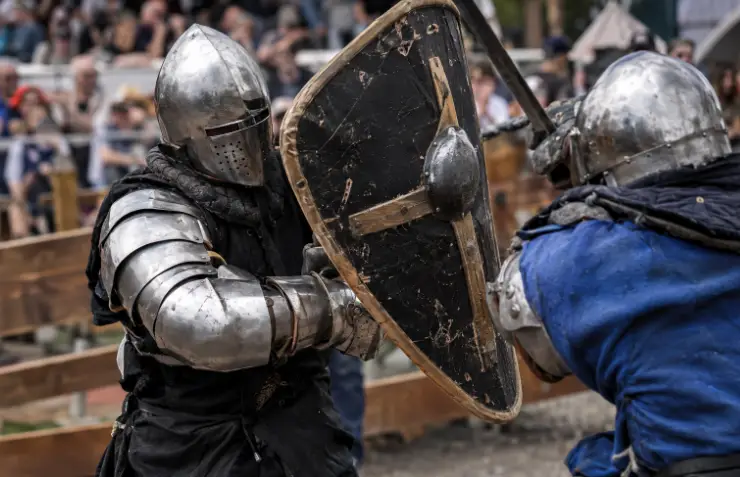
By the 13th century, shortened triangular shields, known as heater shields, had become widespread in armour sets. Later, as knightly combat flourished and metal materials improved, more compact options appeared as part of the armour set. They began to be actively used for foot combat and fencing.
Heater Shields, Bucklers, and Punch Shields
Various types of shields were created by craftsmen of that time for specific combat tasks. For example, teardrop-shaped and triangular models helped cover a substantial part of the torso. Bucklers, on the other hand, provided protection for the hand and helped control the opponent’s actions in the arena. As for modern punch shields, they are specifically designed for the features of modern armoured combat.
At the same time, as history shows, a buckler from the first half of the 16th century, measuring 38 cm in diameter and weighing 1.266 kg, is currently kept in the Bavarian National Museum. Thus, shields should be distinguished according to the following concepts:
- Heater shield. Has a strictly triangular shape and a pointed lower edge.
- Buckler. Distinguished by its small size and central handle for convenience.
- Punch shield. This is a compact model that helps protect the athlete and actively participate in buhurt.
They all differ in size, shape, concept, convenience and specific features of use.
Why Shield Design Matters in Competitive Buhurt
In modern team competitions in this official sport (mass combat in the medieval style), the shield is considered an additional means of protection and a tool for managing the so-called “battle space”. Thanks to its particular shape, it can differ in design, which affects visibility, and can protect the torso and other parts of the body from harmful effects and enemy strikes.
The shield also helps increase the speed of response actions in HMB. For example, an overly heavy construction increases the load on the arm, while an uncomfortable handle can make it difficult to hold during collisions. For this reason, the official requirements of international buhurt provide for certain clearly established restrictions on the size, weight and historical accuracy of shields.
Materials, Grip Systems, and Defensive Control
Special attention is paid to the manufacturing materials and all fastenings, as the reliability of the weapon and how securely it is attached depend on them. The fact is that it must withstand not just one, but several consecutive and repeated strikes. When it comes to modern wooden models, multilayer special plywood, fabric covering (multilayer, leather, etc.) and reinforced edges are used in their production. They are suitable not only for tournaments but also for training.
For example, the requirements for heater shield models specify a length of 55 to 75 centimetres, a width of 30 to 65 cm and a maximum weight of 5 kilograms. Therefore, when choosing a retention system, the athlete’s fighting style must also be taken into account:
- Strap fastenings (enarmes). They secure the shield to the forearm and can provide maximum stability while running, walking and performing other movements.
- Central handle. With its help, the athlete can change their position in the arena/ring and the direction of their defence more quickly.
- Reinforced edge. It helps reduce the likelihood of damage to the edges during combat clashes with an opponent.
The main rule: the shield must be made strictly on the basis of historical examples, correspond to the period of the fighter’s armour and weigh no more than 5 kilograms.
How Medieval Extreme Approaches Shield Craftsmanship
The Medieval Extreme brand offers several types of shields for modern knights – for duelling and team competitions. These tools must combine authenticity (historical outlines and design solutions) with reliability (high-quality manufacturing materials).
Different options can be found in the online catalogue. For example, the Heater Shield measuring 72 × 57 cm, the Punch Shield measuring 63 × 38 cm and the Buckler measuring 32 × 32 cm. Thanks to the wide range, every athlete can choose a suitable protective option (model) for themselves and officially participate in the sport or train when time is available.
Historical Authenticity and Custom Heraldic Designs
According to historical facts, in medieval tournaments, shields could be distinguished exclusively by special inscriptions and images on their surfaces. Such “pictures” were called heraldic images. They immediately showed who the owner was, even though the helmets tightly covered the fighters’ faces. In the 13th century, special coats of arms became a characteristic part of the decoration of European shields.
As for the present day, the Medieval Extreme company helps future owners personalise their heater shields. Essentially, athletes can order complete shields with individual colours, coats of arms, logos and historical designs. At the same time, the company takes into account the fact that the design must correspond to the period of the armour according to competition rules, and the future owner must have the right to use the provided image.
What Modern Fighters Can Learn From Historical Shieldmaking
A lot can be said about historical weapons craftsmanship, but it clearly demonstrates how closely the design of a shield was connected to its direct purpose. When making them, medieval craftsmen took into account the shape of the torso, the position of the arm, load distribution and, of course, the features of their subsequent combat use.
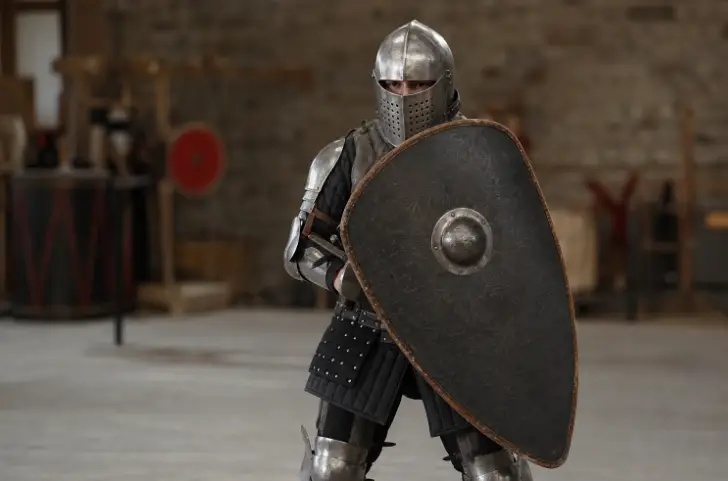
Modern manufacturing brands, on the other hand, preserve this engineering approach but supplement it with testing the strength of the materials used and compliance with sports regulations. Thanks to the carefully thought-out design and high-quality assembly, it is much easier for modern athletes to choose a weapon for their complete set of equipment.